Klimawandel im Spiegel antiker Kulturen
(dg) Am Freitag spreche ich auf der internationalen Klimakonferenz von EIKE über den Klimawandel im Spiegel antiker Kulturen. Im Mittelpunkt meines Vortrags steht die Frage, welche Rolle große Flutkatastrophen seit dem frühen Holozän – also seit etwa 10.000 v. Chr. – für die Kulturgeschichte des Menschen gespielt haben.
Zahlreiche Überlieferungen und archäologische Hinweise deuten darauf hin, dass solche Kataklysmen in verschiedenen Regionen der Alten Welt und Amerikas tiefgreifende Folgen hatten: Sie beeinflussten Siedlungsräume, lösten Migrationsbewegungen aus und setzten neue Besiedlungsimpulse in Gang.
In der Kürze der Zeit werde ich insbesondere auf Beispiele aus Ägypten, Mesopotamien und Altamerika eingehen. Dabei soll gezeigt werden, dass das Studium antiker Flutgeschichten keine Sensationsforschung ist, sondern einen ernstzunehmenden Beitrag zum Verständnis vergangener Umwelt- und Klimadynamiken leisten kann. Es führt uns vor Augen, dass wir auf einem lebendigen Planeten mit großen Ozeanen leben und dass Klima- und Wetterextreme seit jeher zu den Kräften gehören, die menschliche Gesellschaften zu Anpassung, Neuorientierung und Innovation gezwungen haben.

Was erzählen uns alte Sintflutgeschichten über den Ursprung unserer Zivilisation? Welchen reellen Hintergrund haben die Erzählungen der Alten über gewaltige Kataklysmen in der Vorzeit? Darüber berichte ich auf der kommenden Konferenz von EIKE, auf der weltweite Koryphäen der Klimaforschung über ihre Arbeit sprechen. //
What do ancient flood stories tell us about the origins of our civilization? What is the real basis for the stories told by the ancients about massive cataclysms in prehistoric times? I will be discussing this at the upcoming EIKE conference, where leading figures in climate research from around the world will be speaking about their work.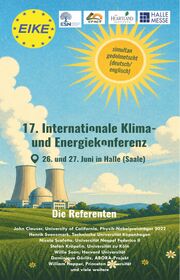
Das offizielle Poster der EIKE-Konferenz 2026. //
The official poster of the EIKE conference 2026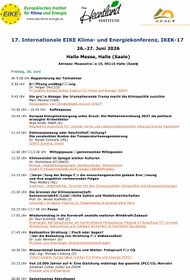
Das Programm mit den Vortragstiteln und Teilnehmern. In der Inhaltsangabe sind auch die Institute und Herkunftsländer geschrieben. Sie dokumentieren, dass hochkarätige Wissenschaftler aus aller Welt in Halle auftreten werden. Hier ist Seite 01. //
The program includes the lecture titles and participants. The table of contents also lists the institutions and countries of origin. It documents that top-class scientists from all over the world will be speaking in Halle. This is page 1.
Das Programm mit den Vortragstiteln und Teilnehmern von Seite 02. Am Ende ist auch die Preisliste an der Tageskasse enthalten. Tickets sind noch verfügbar. //
The program, including lecture titles and participants, is listed on page 2. The price list for the box office is also included at the end. Tickets are still available.
Es ist meine zweite Teilnahme an einer EIKE-Konferenz. Die erste war in Braunsbedra, die unrühmlich mit erheblichen Beschädigungen an unserer Zentralwerkstatt Pfännerhall in Braunsbedra endete. //
This is my second time attending an EIKE conference. My first was in Braunsbedra, which ended ignominiously with significant damage to our central workshop, Pfännerhall, in Braunsbedra.


Climate Change in the Mirror of Ancient Cultures
On Friday, I will be speaking at the international climate conference organized by EIKE on the topic of “Climate Change in the Mirror of Ancient Cultures.” The central question of my lecture is what role major flood catastrophes have played in human cultural history since the early Holocene—that is, since around 10,000 BC.
Numerous traditions and archaeological indications suggest that such cataclysms had profound consequences in various regions of the Old World and the Americas: they affected settlement areas, triggered migration movements, and initiated new waves of colonization and resettlement.
Given the limited time available, I will focus in particular on examples from Egypt, Mesopotamia, and Pre-Columbian America. The aim is to show that the study of ancient flood traditions is not a matter of sensationalism, but can make a serious contribution to our understanding of past environmental and climatic dynamics. It reminds us that we live on a dynamic planet with vast oceans, and that climatic and weather extremes have always been among the forces that compelled human societies to adapt, reorient themselves, and innovate.
